
Vape Industry Trends Shaping 2026 Supply Chains
Time
Click Count
As regulation, automation, and harm-reduction science converge, the vape industry is entering a decisive supply chain reset in 2026.
Competitiveness will no longer depend only on device volume or flavor speed.
It will depend on compliance-ready manufacturing, safer aerosol technologies, battery reliability, and agile global distribution.
From Shenzhen’s OEM dominance to PMTA-driven barriers, these signals define resilience, margin growth, and access to regulated nicotine markets.
Scenario Background: Why Vape Industry Supply Chains Are Splitting in 2026
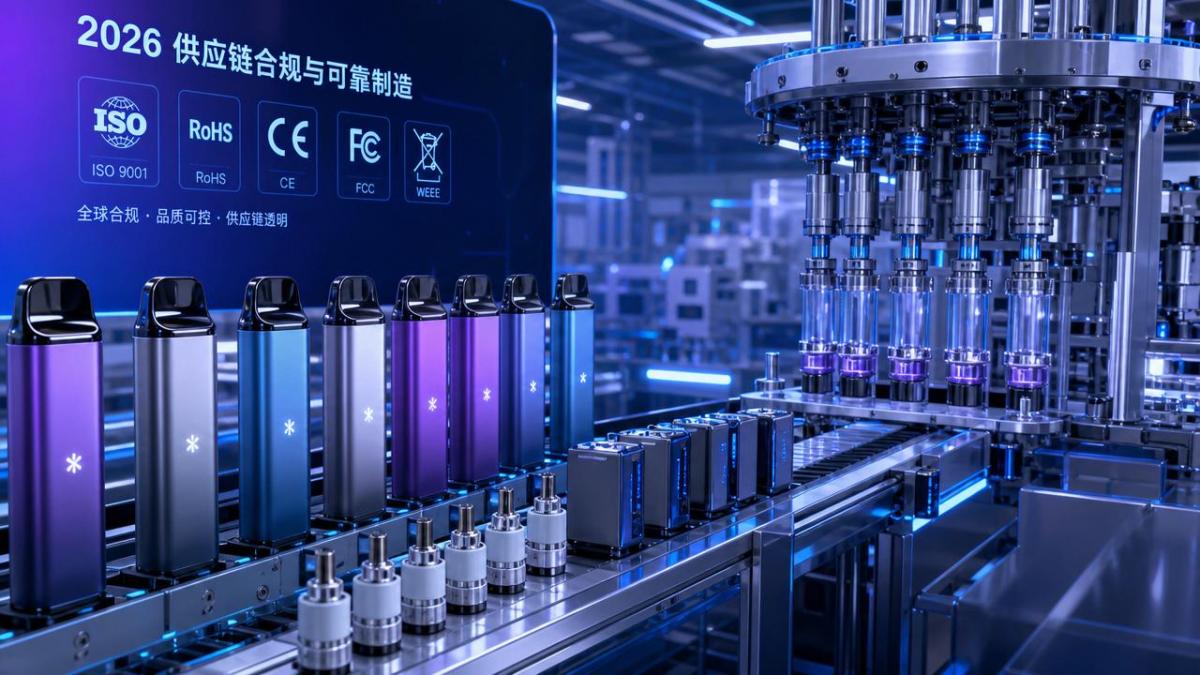
The vape industry is moving from fast product launches toward controlled, evidence-backed supply chains.
This shift changes how disposable devices, pods, ceramic coils, HNB systems, batteries, and e-liquids are planned.
Each market scenario now has different risk weightings.
A flavor-led market may prioritize short testing cycles, while a regulated market may prioritize toxicology files.
The vape industry must also manage divergent expectations around sustainability, child protection, and nicotine delivery consistency.
Shenzhen remains central because it concentrates automation, tooling, battery sourcing, filling lines, and aerosol engineering.
However, dominance alone is not enough in 2026.
Export success increasingly requires documented process control, traceable materials, and region-specific compliance architecture.
Scenario One: Regulated Nicotine Markets Demand Compliance-First Design
In the United States, the vape industry faces PMTA expectations shaped by chemistry, toxicology, and product stability.
The strongest supply chains will build documentation before the first commercial launch.
This scenario requires ingredient traceability, HPHC testing, aerosol particle analysis, and battery safety validation.
Compliance cannot be repaired at the final export stage.
For the vape industry, PMTA readiness influences supplier selection, device structure, coil chemistry, and packaging language.
A small design change may trigger new evidence requirements.
The core judgment point is whether a product platform can survive regulatory review without constant redesign.
Stable platforms reduce testing duplication and improve long-term market access.
Scenario Two: Disposable Vape Growth Requires Safer High-Volume Automation
Disposable devices remain a growth engine in the vape industry, especially smart disposables with screens and higher puff counts.
Yet scale introduces new failure points across filling, sealing, welding, and battery integration.
Automated filling lines must control liquid weight, viscosity changes, and leakage risks.
Peristaltic pumps, ultrasonic welding, and negative-pressure leak tests become strategic assets.
The core judgment point is process repeatability under daily mass production.
A device with attractive styling can fail if aerosol delivery changes after transport or storage.
In 2026, the vape industry will reward lines that combine speed with measurable defect reduction.
Output volume matters, but warranty exposure and recall risk matter more.
Scenario Three: Ceramic Coil Platforms Define Flavor Consistency and Safety
Microporous ceramic coils are becoming a decisive platform choice in the vape industry.
Their value comes from controlled capillary action, even liquid transfer, and stable heating surfaces.
When PG/VG ratios shift, capillary behavior, aerosol density, and flavor release also change.
This makes ceramic structure a supply chain decision, not only a component decision.
The core judgment point is matching pore geometry with liquid formula and power curve.
Poor matching may cause dry hits, flavor fading, overheating, or abnormal emissions.
The vape industry will favor coil platforms verified through thermal mapping and aerosol chemistry data.
This creates a bridge between flavor engineering and toxicological safety.
Scenario Four: HNB Systems Need Precision Heating and Tobacco Stick Alignment
Heat-not-burn products occupy a different scenario inside the broader vape industry.
They serve users who prefer tobacco aroma while seeking reduced combustion exposure.
HNB supply chains depend on thermal precision, stick compatibility, and heating element durability.
Ceramic blades and induction systems must maintain controlled temperatures near the intended range.
The core judgment point is the stability of nicotine release without reaching open-flame combustion.
Small temperature deviations may affect aroma, emissions, and consumer acceptance.
For the vape industry, HNB expansion requires closer integration between device design and consumable specification.
This model is less agile than disposables, but may support stronger regulatory narratives.
Scenario Five: Regional Distribution Needs Modular Platforms and Local Flavor Speed
Emerging regional markets often reward speed, localization, and controlled inventory risk.
The vape industry responds through modular public molds, flexible labeling, and rapid flavor testing.
This scenario is common where distributors test demand before committing to large proprietary tooling.
It supports faster market entry, but quality governance must remain disciplined.
The core judgment point is whether modularity reduces cost without weakening differentiation or compliance readiness.
Short-cycle flavor launches must still pass stability, leakage, and labeling checks.
In the vape industry, the winning model combines agile incubation with locked technical baselines.
This keeps regional customization from becoming uncontrolled SKU chaos.
Different Scenario Requirements Across the Vape Industry Supply Chain
This comparison shows why one universal supply chain strategy no longer fits the vape industry.
Each scenario has a different balance between speed, evidence, cost, and risk control.
Scenario Adaptation: Practical Moves for 2026 Resilience
Supply chain adaptation should start with product platform classification.
The vape industry needs fewer uncontrolled variants and more validated families of devices.
- Build compliance files alongside formulation and hardware development.
- Use ceramic coil data to guide e-liquid viscosity and power settings.
- Validate batteries under transport, charging, storage, and high-load conditions.
- Separate regulated-market SKUs from rapid-testing regional SKUs.
- Track leakage, flavor drift, screen failure, and charging defects by batch.
These actions help the vape industry turn uncertainty into measurable operating rules.
They also protect margins when regulators, retailers, and logistics channels tighten acceptance standards.
Common Misjudgments That Weaken Vape Industry Decisions
A frequent mistake is treating flavor speed as the only market advantage.
Flavor matters, but unstable aerosol output can damage repeat purchase and compliance confidence.
Another misjudgment is assuming battery safety is solved by sourcing a known cell.
Device structure, charging logic, insulation, and thermal management also shape risk.
A third mistake is overusing public molds without controlling formulation and component tolerances.
The vape industry can move quickly, but uncontrolled substitutions create hidden failure costs.
The final blind spot is delaying regulatory strategy until distribution is already arranged.
By then, packaging, chemistry, nicotine concentration, and device parameters may already conflict with market rules.
Action Guide: Turning Vape Industry Trends into Supply Chain Advantage
The next step is to map each target market to a defined technical and compliance scenario.
That map should connect device type, coil platform, e-liquid profile, battery architecture, and required evidence.
EVTS supports this work through intelligence on disposable vapes, ceramic coils, HNB technology, automation, and PMTA testing.
Its focus on aerosol fluidics, toxicology, and export compliance reflects the vape industry’s 2026 operating reality.
A resilient strategy should begin with three decisions.
- Choose which markets require full compliance-first product architecture.
- Select validated coil, battery, and filling platforms before flavor expansion.
- Create batch-level data loops for defects, emissions, and consumer feedback.
In 2026, the vape industry will not be defined only by who launches fastest.
It will be defined by who links safer nicotine delivery, repeatable manufacturing, and credible regulatory access.
That is the practical route toward durable supply chain power in global harm-reduction markets.
Recommended News
 Sep 12, 2026How TPD rules shape e-liquid formulation science in EuropeDr. Silas Vance
 Sep 11, 2026What drives vape device engineering cost in a new product launch?Mr. Julian Thorne
 Sep 10, 2026What drives PMTA submission cost for a new vape product?Dr. Silas Vance
 Sep 09, 2026How induction heating defines the performance of HNB technologyThermal Pyrolysis Expert
 Sep 08, 2026Which vape export regulations must distributors verify before shipping?Dr. Silas Vance
 Sep 07, 2026What drives nicotine delivery technology cost for new products?Mr. Julian Thorne
 Sep 07, 2026What factors shape electronic vaping industry investment decisions?Mr. Julian Thorne
 Sep 04, 2026What is driving the next-generation nicotine products market?Mr. Julian Thorne
 Sep 03, 2026Which compliance requirements should be cleared before entering a vape market?Dr. Silas Vance
 Sep 02, 2026How is pod child resistant packaging tested for TPD compliance?Toxicology & Compliance Fellow
 Sep 01, 2026Which route to market best fits a UK vape market entry strategy?Mr. Julian Thorne
 Aug 31, 2026How to assess HNB technology compliance before entering the EU marketDr. Silas Vance
 Aug 30, 2026How battery discharge rate affects vape device engineering choicesToxicology & Compliance Fellow
 Aug 29, 2026How leak testing supports e-liquid leak prevention in closed pod systemsVape Production Strategist
 Aug 28, 2026What should a vape adverse event report include for PMTA compliance?Dr. Silas Vance
 Aug 27, 2026How PMTA testing shapes electronic vaping industry complianceToxicology & Compliance Fellow
 Aug 26, 2026What a vape industry innovation report can reveal about supply chain shiftsMr. Julian Thorne
 Aug 25, 2026How leak detection vape cartridges reduce fill loss in productionVape Production Strategist
 Aug 24, 2026Do rechargeable disposable vaping devices last long enough to justify the extra costVaping Hardware Architect
 Aug 23, 2026What PG VG ratio for pods gives the best balance of flavor and leaksVaping Hardware Architect
 Aug 22, 2026What drives pod vaping systems price differences across suppliersVaping Hardware Architect
 Aug 21, 2026What drives Vape Risk Management cost in regulated product launchesMr. Julian Thorne
 Aug 20, 2026How to assess e-liquid safety before starting a vape product lineDr. Silas Vance
 Aug 19, 2026What HPHC panels are required for tobacco product compliance testingToxicology & Compliance Fellow


