FDA Clears First Mango and Blueberry Vapes
Time
Click Count
On May 31, 2026, the U.S. FDA formally announced a notable PMTA-related shift for flavored e-cigarettes by authorizing four Glas fruit-flavored products and, at the same time, signaling a more lenient enforcement approach for products that have had PMTA submissions pending for at least 180 days. For exporters, testing providers, compliance service firms, and OEM manufacturers serving the U.S.-standard market, this matters less as a headline alone and more as a change in how flavor product access, documentation planning, and delivery risk may now be assessed.
What the FDA announcement confirms
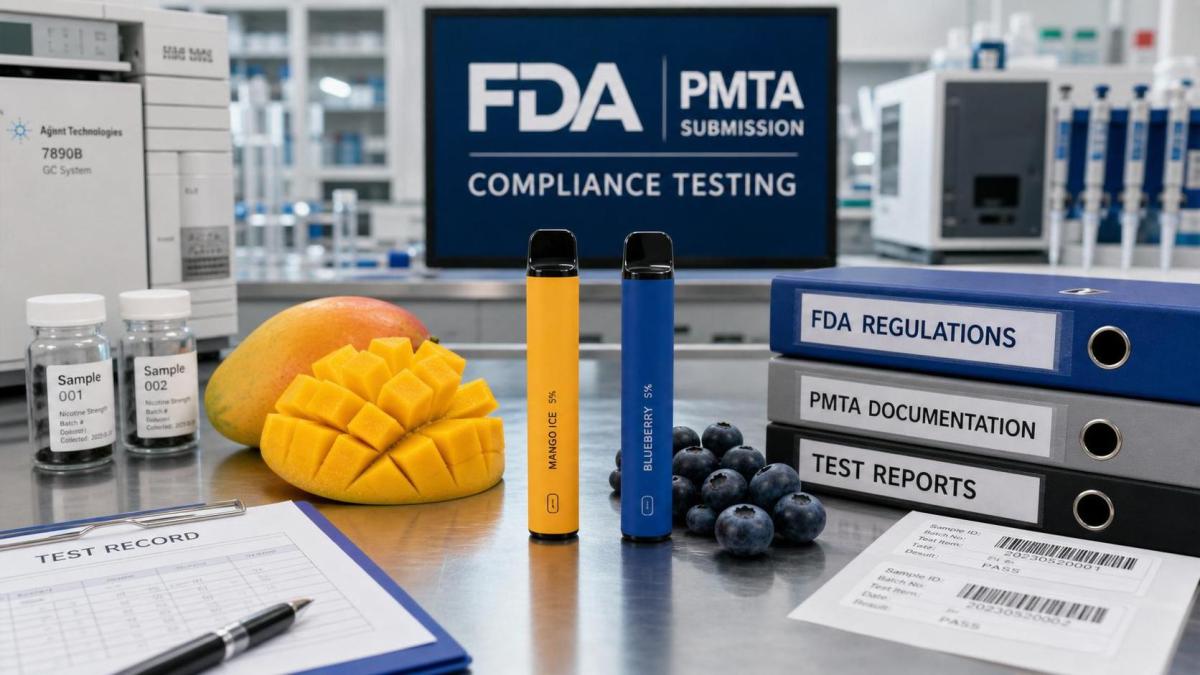
The confirmed facts in this case are limited but significant. According to the provided event summary, the FDA in May 2026 approved four fruit-flavored e-cigarette products under the Glas brand through the PMTA pathway, including mango and blueberry flavors. This breaks with the long-standing pattern in which only tobacco- or menthol-flavored products were understood to be allowed.
The same summary also states that the FDA issued a looser enforcement detail: products with PMTA submissions pending for more than 180 days and without a final response are not currently treated as priority targets for enforcement. Based on the information provided, these two points together reduce uncertainty around market access for U.S.-standard flavored products and create a clearer compliance route for flavored disposable and closed-system vapor devices.
Where the rule change may be felt first
Export programs for flavored devices
From an industry perspective, exporters focused on flavored disposable and closed-system products may be among the first to reassess their U.S.-bound product pipelines. The reason is straightforward: the announcement changes the practical compliance reading of what types of flavored products may have a viable PMTA path. The impact is likely to be felt in product selection, launch sequencing, dossier preparation, and shipment planning rather than in simple sales expectations.
What deserves closer attention is whether export teams now adjust internal compliance gates for flavor projects, especially around PMTA filing status, supporting technical documents, and delivery schedules linked to products intended for the U.S. market.
PMTA filing and dual-compliance service providers
Providers that support PMTA submissions, as well as laboratories positioned around both TPD and PMTA compliance, may see a more immediate operational effect. Analysis shows that a clearer route for flavored products can increase demand for application support, testing coordination, document review, and cross-market compliance alignment. In practice, these firms will need to pay close attention to whether clients require revised testing scopes, updated technical files, or more detailed submission planning tied specifically to flavor product categories.
OEM factories with HPHCs toxicology capability
Manufacturers that already have HPHCs toxicology testing capability may become more relevant in customer qualification and order allocation. The reason is not that approval becomes automatic, but that buyers may place greater value on factories able to support PMTA-oriented evidence preparation, technical traceability, and compliance-ready production records. The operational effect may appear in supplier screening, sampling arrangements, and the completeness of manufacturing documentation used in export transactions.
Practical issues companies should now track
Check whether internal compliance assumptions still hold
Analysis shows that many companies may have built U.S. flavor strategies around a narrow assumption that only tobacco or menthol pathways were workable. This announcement suggests those assumptions should be reviewed. Businesses should focus on whether their existing product classification, submission plans, and customer communication materials still match the latest regulatory signal described in the event summary.
Prepare documents around filing status and technical support
What deserves closer attention is the documentary side of trade execution. Where PMTA timing affects shipment decisions, companies may need clearer internal records on submission dates, product scope, testing support, and technical file consistency. The provided information does not give detailed execution rules, so this should be treated as a compliance checkpoint rather than as proof of automatic marketability.
Reassess supplier and laboratory readiness
Observably, the announcement may shift buyer attention toward suppliers and service partners that can support PMTA-related documentation, TPD/PMTA dual-compliance work, and HPHCs toxicology testing. For procurement and supply chain teams, this means reviewing whether existing laboratories, OEM partners, and compliance vendors can meet tighter expectations on data support, report completeness, and delivery coordination.
Watch post-announcement enforcement language carefully
The summary indicates that products pending for more than 180 days are not a priority enforcement target, but it does not provide full implementation detail. For that reason, companies should pay attention to subsequent official wording, practical enforcement interpretation, and any downstream changes in customer requirements, order terms, or acceptance criteria. It is more appropriate to understand this as a meaningful signal with operational implications, not as a substitute for product-by-product compliance review.
Why this looks like an execution signal, not a final endpoint
Analysis shows that this development is important because it combines two elements at once: product authorization for fruit flavors and a softer enforcement posture for certain pending submissions. Taken together, that is more than a routine product approval update. It suggests that the compliance path for flavored U.S.-standard vapor products may now be read with less uncertainty than before.
At the same time, observably, the input does not provide full downstream rule detail, broader implementation standards, or later market responses. For that reason, the industry still needs to watch how certification language, customer purchasing criteria, and execution practice evolve after the announcement.
How the market may best read this development
A rational reading of this event is that it marks a clearer regulatory and compliance signal for flavored e-cigarette exports tied to the PMTA route, especially for service providers, testing laboratories, and OEM factories that already support U.S.-standard technical requirements. It should not, however, be overstated as a blanket conclusion for all products or all market participants.
Current conditions make it more appropriate to understand this development as an implemented change with immediate practical relevance, while also recognizing that the finer points of execution, customer adoption, and compliance interpretation still require continued observation.
Basis of this article and what still needs checking
This article is generated from the user-provided news title, event date, and event summary. For developments of this kind, relevant source types commonly include official announcements, regulatory agency releases, trade authority information, industry association updates, standards documents, and reporting by established professional media. A specific official source link was not provided in the input, so that link still needs to be verified on an ongoing basis.
Further observation should focus on later policy details, certification and compliance interpretation, changes in procurement or bidding documents, industry feedback, and how companies translate the announcement into actual export and delivery practice.
Recommended News
 Sep 14, 2026What should a vape risk management supplier audit verify?Dr. Silas Vance
 Sep 12, 2026How TPD rules shape e-liquid formulation science in EuropeDr. Silas Vance
 Sep 11, 2026What drives vape device engineering cost in a new product launch?Mr. Julian Thorne
 Sep 10, 2026What drives PMTA submission cost for a new vape product?Dr. Silas Vance
 Sep 09, 2026How induction heating defines the performance of HNB technologyThermal Pyrolysis Expert
 Sep 08, 2026Which vape export regulations must distributors verify before shipping?Dr. Silas Vance
 Sep 07, 2026What drives nicotine delivery technology cost for new products?Mr. Julian Thorne
 Sep 07, 2026What factors shape electronic vaping industry investment decisions?Mr. Julian Thorne
 Sep 04, 2026What is driving the next-generation nicotine products market?Mr. Julian Thorne
 Sep 03, 2026Which compliance requirements should be cleared before entering a vape market?Dr. Silas Vance
 Sep 02, 2026How is pod child resistant packaging tested for TPD compliance?Toxicology & Compliance Fellow
 Sep 01, 2026Which route to market best fits a UK vape market entry strategy?Mr. Julian Thorne
 Aug 31, 2026How to assess HNB technology compliance before entering the EU marketDr. Silas Vance
 Aug 30, 2026How battery discharge rate affects vape device engineering choicesToxicology & Compliance Fellow
 Aug 29, 2026How leak testing supports e-liquid leak prevention in closed pod systemsVape Production Strategist
 Aug 28, 2026What should a vape adverse event report include for PMTA compliance?Dr. Silas Vance
 Aug 27, 2026How PMTA testing shapes electronic vaping industry complianceToxicology & Compliance Fellow
 Aug 26, 2026What a vape industry innovation report can reveal about supply chain shiftsMr. Julian Thorne
 Aug 25, 2026How leak detection vape cartridges reduce fill loss in productionVape Production Strategist
 Aug 24, 2026Do rechargeable disposable vaping devices last long enough to justify the extra costVaping Hardware Architect
 Aug 23, 2026What PG VG ratio for pods gives the best balance of flavor and leaksVaping Hardware Architect
 Aug 22, 2026What drives pod vaping systems price differences across suppliersVaping Hardware Architect
 Aug 21, 2026What drives Vape Risk Management cost in regulated product launchesMr. Julian Thorne
 Aug 20, 2026How to assess e-liquid safety before starting a vape product lineDr. Silas Vance