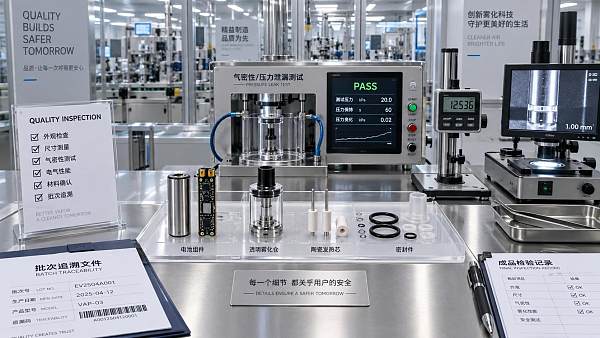
Vape Manufacturing Cost Drivers in Automated Lines
Time
Click Count
Vape manufacturing costs in automated lines are shaped by far more than equipment price.
True unit economics depend on filling accuracy, yield loss, leak-test failures, coil consistency, battery controls, compliance documentation, and labor displacement.
In regulated markets, PMTA, TPD, and traceability can decide whether automation protects margin or creates a costly bottleneck.
What Really Drives Vape Manufacturing Cost in Automated Lines?
The largest vape manufacturing cost drivers usually sit inside process variation, not inside the purchase order for machines.
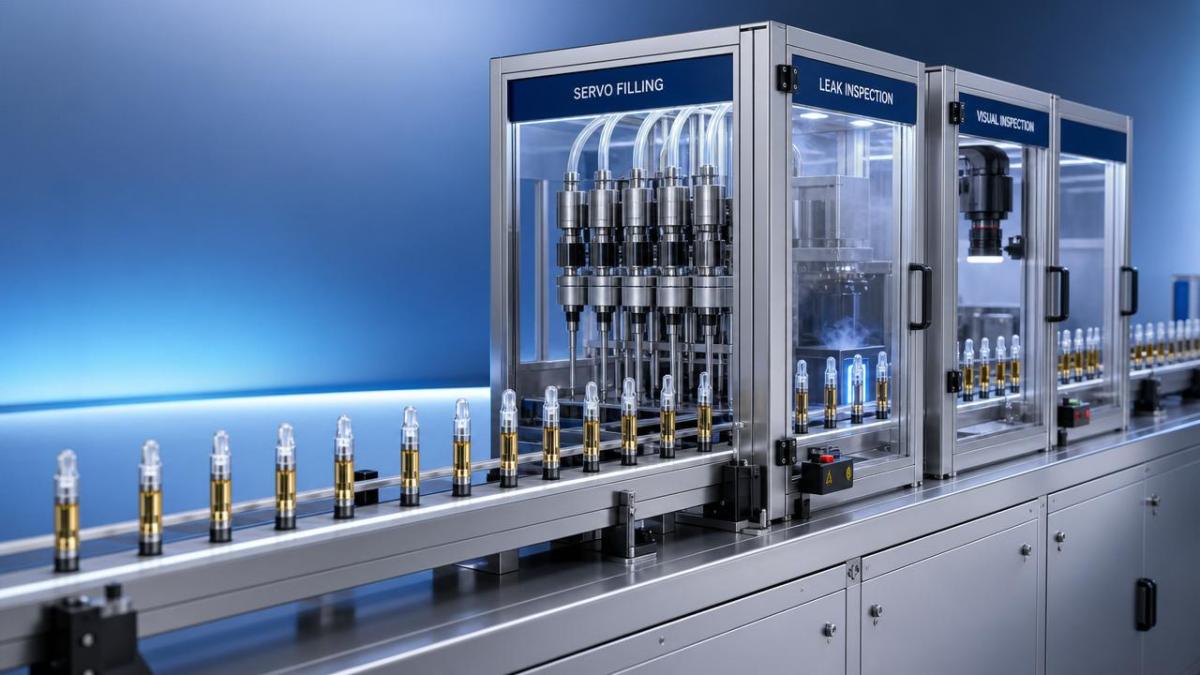
Automated filling, ultrasonic welding, battery placement, leak testing, and vision inspection all affect the final cost per sellable device.
A fast line is valuable only when it delivers stable output, repeatable quality, and compliant records at commercial scale.
In vape manufacturing, one hidden cost is micro-loss across thousands of cycles.
A 0.01g filling deviation may look small, but millions of pods convert that variance into material waste or regulatory risk.
Another driver is rejection after value has already been added.
If a pod fails leak testing after coil, battery, shell, and e-liquid integration, the scrap cost is much higher.
Core cost layers to measure
- Capital equipment, tooling, fixtures, and changeover kits.
- E-liquid, ceramic coils, batteries, seals, housings, and packaging.
- Yield loss from filling, welding, aging, transport, and leak testing.
- Inspection labor, maintenance labor, engineering support, and training.
- Compliance records, batch traceability, testing reports, and audit readiness.
How Does Filling Accuracy Change Vape Manufacturing Economics?
Filling accuracy is one of the most sensitive variables in vape manufacturing.
Automated peristaltic pumps, ceramic pump systems, and servo-controlled dispensers must match viscosity, temperature, and pod geometry.
PG/VG ratio changes flow behavior, bubble formation, and settling time.
High-VG formulas may require different pump curves, nozzle diameters, and anti-drip strategies.
Overfilling raises material cost and may breach capacity rules in strict markets.
Underfilling damages consumer trust and can trigger complaints, returns, or failed acceptance sampling.
For 2ml TPD products, the tolerance window is not only financial.
It also connects vape manufacturing performance with legal packaging claims and market access.
Practical controls for filling cost
- Calibrate filling heads by formula, temperature, and target volume.
- Use checkweighing feedback for closed-loop correction.
- Track nozzle clogging, dripping, foaming, and air entrapment.
- Separate engineering trials from validated production recipes.
- Monitor e-liquid loss during purging, changeover, and cleaning.
A strong vape manufacturing model should price e-liquid loss as a repeating cost, not as occasional waste.
Why Do Yield Loss and Leak Tests Matter More Than Line Speed?
High speed without stable yield can reduce profit.
In automated vape manufacturing, hourly output should be judged together with first-pass yield and final release rate.
Leak testing is especially important because disposable and pod devices combine liquid, air channels, seals, and pressure-sensitive structures.
Negative-pressure testing, decay testing, and visual detection each catch different failure patterns.
A leak may come from poor welding, seal compression, shell tolerance, wick saturation, or thermal expansion during storage.
If root causes are not separated, the line may reject good products or release weak products.
Both outcomes increase vape manufacturing cost.
Speed versus economic output
The best vape manufacturing decisions compare sellable units per shift, not machine cycles per minute.
How Do Coil, Battery, and Aerosol Controls Affect Total Cost?
Coil quality strongly influences flavor consistency, aerosol density, and complaint rates.
Microporous ceramic coils depend on pore uniformity, capillary transport, sintering stability, and heating-surface consistency.
If liquid supply is uneven, dry-hit risk rises and flavor reproduction becomes unstable.
In vape manufacturing, coil inconsistency often appears as warranty cost, brand damage, or additional screening.
Battery cost is also more complex than cell price.
High-rate lithium cells require incoming inspection, insulation control, welding validation, short-circuit protection, and aging tests.
Smart disposables add screens, MCUs, charging ports, and firmware behaviors.
These features raise bill-of-material cost, but they can reduce returns when battery and liquid display accuracy is reliable.
Where hidden component costs appear
- Extra coil screening for resistance, porosity, and thermal response.
- Battery aging time that consumes floor space and work-in-process cash.
- Firmware verification for puff counting and safety cutoff logic.
- Additional inspection after ultrasonic welding or laser marking.
- Return handling when flavor, leakage, or charging failures occur.
A realistic vape manufacturing budget links components with downstream testing requirements.
What Compliance Costs Should Be Included Before Automation Approval?
Compliance cost is often underestimated because it does not look like production cost.
However, regulated vape manufacturing needs documentation from raw materials to finished shipment.
PMTA markets require toxicology evidence, HPHC analysis, stability data, labeling control, and manufacturing process descriptions.
European TPD requirements add capacity limits, notification files, emissions checks, and packaging obligations.
Automation can reduce compliance burden when machines capture accurate batch data.
It can also increase cost if data systems, sensors, and validation protocols are added too late.
Traceability should cover e-liquid batch, coil batch, battery lot, operator intervention, machine settings, and test result history.
For export-oriented vape manufacturing, these records may decide whether a shipment survives audit, dispute, or recall investigation.
Compliance cost checklist
When Does Automation Lower Vape Manufacturing Cost?
Automation lowers cost when volume, product stability, and quality requirements are aligned.
It is strongest for mature SKUs with predictable demand, stable formulas, and repeatable component supply.
It is weaker when flavor testing changes frequently, packaging changes weekly, or public molds need constant adjustment.
In Shenzhen-style vape manufacturing ecosystems, modular tooling can shorten launch cycles.
Yet every new flavor, coil, and shell combination still needs validation before high-speed release.
The most useful investment model separates fixed automation cost from variable quality cost.
A cheaper line may become expensive if it requires frequent stoppages, manual rework, or offline inspection.
Decision questions before scaling
- Is expected demand high enough to absorb depreciation?
- Can the same platform support multiple SKUs without long changeovers?
- Are filling, welding, and leak-test parameters already stable?
- Can suppliers meet tighter tolerances at larger volume?
- Does the line produce records suitable for PMTA, TPD, or customer audits?
Automation is not only labor replacement.
In advanced vape manufacturing, it is a system for controlling variation, evidence, and release speed.
What Mistakes Distort Vape Manufacturing Cost Forecasts?
The first mistake is comparing only machine quotations.
The real comparison should include fixtures, spare parts, software, validation, service response, and integration with existing processes.
The second mistake is assuming all scrap has the same value.
Early component rejection is cheaper than failure after e-liquid filling and final assembly.
The third mistake is ignoring product lifecycle.
A line designed for one blockbuster disposable may struggle when regulations or consumer taste shifts.
The fourth mistake is treating compliance as a final paperwork task.
In vape manufacturing, compliance should influence design controls, material selection, test plans, and data architecture from the start.
FAQ summary for cost review
Conclusion: How to Build a Practical Vape Manufacturing Cost Model
A strong cost model starts with the finished, compliant, sellable device.
Then it works backward through filling accuracy, leak testing, coil behavior, battery safety, labor, downtime, and documentation.
The best vape manufacturing automation projects do not chase speed alone.
They reduce variation, protect flavor consistency, strengthen safety, and create audit-ready evidence.
Before approving an automated line, build a scenario model for volume, yield, scrap stage, compliance burden, and changeover frequency.
That approach turns vape manufacturing from a capital expense debate into a margin, quality, and market-access strategy.
Recommended News
 Sep 15, 2026How to assess a nicotine delivery technology supplier’s PMTA testing capabilityToxicology & Compliance Fellow
 Sep 14, 2026What should a vape risk management supplier audit verify?Dr. Silas Vance
 Sep 12, 2026How TPD rules shape e-liquid formulation science in EuropeDr. Silas Vance
 Sep 11, 2026What drives vape device engineering cost in a new product launch?Mr. Julian Thorne
 Sep 10, 2026What drives PMTA submission cost for a new vape product?Dr. Silas Vance
 Sep 09, 2026How induction heating defines the performance of HNB technologyThermal Pyrolysis Expert
 Sep 08, 2026Which vape export regulations must distributors verify before shipping?Dr. Silas Vance
 Sep 07, 2026What drives nicotine delivery technology cost for new products?Mr. Julian Thorne
 Sep 07, 2026What factors shape electronic vaping industry investment decisions?Mr. Julian Thorne
 Sep 04, 2026What is driving the next-generation nicotine products market?Mr. Julian Thorne
 Sep 03, 2026Which compliance requirements should be cleared before entering a vape market?Dr. Silas Vance
 Sep 02, 2026How is pod child resistant packaging tested for TPD compliance?Toxicology & Compliance Fellow
 Sep 01, 2026Which route to market best fits a UK vape market entry strategy?Mr. Julian Thorne
 Aug 31, 2026How to assess HNB technology compliance before entering the EU marketDr. Silas Vance
 Aug 30, 2026How battery discharge rate affects vape device engineering choicesToxicology & Compliance Fellow
 Aug 29, 2026How leak testing supports e-liquid leak prevention in closed pod systemsVape Production Strategist
 Aug 28, 2026What should a vape adverse event report include for PMTA compliance?Dr. Silas Vance
 Aug 27, 2026How PMTA testing shapes electronic vaping industry complianceToxicology & Compliance Fellow
 Aug 26, 2026What a vape industry innovation report can reveal about supply chain shiftsMr. Julian Thorne
 Aug 25, 2026How leak detection vape cartridges reduce fill loss in productionVape Production Strategist
 Aug 24, 2026Do rechargeable disposable vaping devices last long enough to justify the extra costVaping Hardware Architect
 Aug 23, 2026What PG VG ratio for pods gives the best balance of flavor and leaksVaping Hardware Architect
 Aug 22, 2026What drives pod vaping systems price differences across suppliersVaping Hardware Architect
 Aug 21, 2026What drives Vape Risk Management cost in regulated product launchesMr. Julian Thorne